Introduction
Rain, humidity, and freeze-thaw swings don't take days off. Exterior walls absorb all of it, year after year, until paint peels, hairline cracks widen, and water finds its way inside.
The financial stakes are real. Commercial water-damage claims average $50,000 to $100,000, according to a Facility Executive report on leak detection. Water intrusion also drives more than 30% of construction-related insurance losses, per a Builder magazine report on builders risk insurance claims.
Waterproofing paint exists to stop that cycle before it starts. This guide breaks down the top products on the market and how to pick the right one for your walls. It also covers when a newer approach, ceramic coatings, might outperform paint entirely.
Key Takeaways
- Waterproofing paint blocks moisture on brick, stucco, and concrete; regular paint doesn't
- Substrate type and climate exposure matter more than brand name when choosing a product
- DRYLOK, KILZ, Behr, Sherwin-Williams, and Foundation Armor each target different wall conditions
- Surface prep and correct coat count determine performance as much as the product itself
- Ceramic coatings offer a longer-lasting alternative to repainting every 5-10 years
Overview of Waterproofing Paint for Exterior Walls in the US Market
Waterproofing paint is a specialized coating that creates a water-repelling barrier on porous exterior surfaces like brick, stucco, and concrete block. It's built to withstand standing moisture, wind-driven rain, and freeze-thaw stress, unlike standard exterior paint, which is designed mainly for color and UV protection.
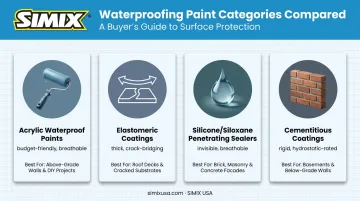
The category isn't one-size-fits-all. Four main formulation types dominate the US market:
- Acrylic waterproof paints: general-purpose, budget-friendly
- Elastomeric coatings: thick, flexible, crack-bridging
- Silicone/siloxane penetrating sealers: invisible, breathable protection
- Cementitious coatings: rigid, built for below-grade pressure
Each serves a distinct wall condition, which is exactly why the "best" product depends on your specific situation, not just star ratings.
The Four Waterproofing Paint Types Explained
Acrylic waterproof paints are the most common starting point for homeowners. They're breathable, cost-effective, and work well on above-grade stucco, brick, or block that isn't under constant water pressure. KILZ's Masonry, Stucco & Brick Flat Paint falls into this category as an acrylic latex, water-repellent finish.
Elastomeric coatings apply much thicker than standard paint, sometimes 10 times the film build. That thickness lets them stretch and bridge hairline cracks as walls expand and contract with temperature. Behr's elastomeric masonry line is engineered specifically for this kind of movement.
Silicone and siloxane-based masonry creams work differently. Instead of forming a surface film, they penetrate into the pores of brick or stone and react chemically to create a hydrophobic barrier. The wall still breathes, and its natural texture stays visible. Foundation Armor's SX5000 is a leading example.
Cementitious waterproof coatings are the heavy-duty option, typically reserved for below-grade walls facing constant hydrostatic pressure. Foundation walls holding back groundwater are a common example. They're rigid and mineral-based rather than flexible.
With the categories defined, here's how five specific products stack up against each other.
Top 5 Best Waterproofing Paints for Exterior Walls
Selection came down to five factors: documented durability, water or hydrostatic resistance, breathability, ease of application, and market reputation among contractors and DIYers alike.
DRYLOK Extreme Masonry Waterproofer
UGL, founded in 1932, has sold DRYLOK products since 1953, making it one of the longest-standing names in US masonry waterproofing. It's now part of Sika's portfolio and remains a hardware-store staple.
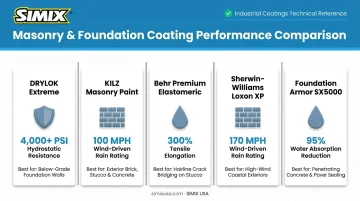
DRYLOK Extreme stands out because it's tested to ASTM D7088 hydrostatic-pressure standards, a rare claim among retail-shelf products. It also carries wind-driven rain testing under ASTM D6904.
| Category | Details |
|---|---|
| Best For | Concrete block, brick, stucco, and poured concrete walls, including below-grade masonry |
| Key Features | Rated to withstand 15 PSI (equivalent to a 33-foot water head); Category 4 wind-driven rain resistance up to 140 mph; 15-year warranty; tintable in Bright White and Gray bases |
| Application Notes | Roller or brush application; minimum two coats required; light tint shades limited to 2 fl oz of colorant per gallon |
KILZ Masonry, Stucco & Brick Waterproofing Paint
KILZ built its reputation on interior primers before expanding into exterior masonry coatings. This product is officially classified as an acrylic latex, water-repellent paint rather than a hydrostatic waterproofer, an important distinction when setting performance expectations.
Its key advantage is a self-priming, mildew-resistant formula designed for porous above-grade surfaces exposed to efflorescence and mild alkali conditions.
| Category | Details |
|---|---|
| Best For | Stucco, brick, and concrete block walls prone to surface staining and mildew |
| Key Features | Alkali-resistant to pH 12.0; mildew-resistant finish; self-priming; one-year product warranty |
| Application Notes | Surface must be clean, cured, and free of loose efflorescence; apply by brush, roller, or spray; second coat optional if needed |
Behr Premium Elastomeric Masonry, Stucco & Brick Paint
Sold through Home Depot, Behr's elastomeric line is the brand's answer to walls that move, crack, and shift with the seasons. This is distinct from Behr's standard masonry paint, which lacks the same flexible, waterproof claims.
What sets it apart is a flexible 100% acrylic latex film rated to bridge existing hairline cracks while remaining breathable, backed by a Limited Lifetime Guarantee for the original homeowner.
| Category | Details |
|---|---|
| Best For | DIY homeowners waterproofing brick, block, or stucco with minor surface cracking |
| Key Features | Limited Lifetime Guarantee; 98-mph wind-driven rain resistance; tintable to 90 custom colors; 20-year design life cited in Behr's environmental product declaration |
| Application Notes | Two coats required for full performance; roller or spray application; best applied in dry, moderate temperatures |
Sherwin-Williams Loxon XP Waterproofing Masonry Coating
Sherwin-Williams built Loxon XP as a professional-grade option, and it shows in the technical documentation. Contractors use it on everything from apartment complexes to institutional buildings.
The defining feature is flexibility: it's rated for 335.4% tensile elongation under ASTM D412 testing, meaning it stretches significantly before failing, well beyond typical acrylic paints.
| Category | Details |
|---|---|
| Best For | Commercial buildings, multi-family housing, and large stucco or concrete masonry unit (CMU) surfaces |
| Key Features | Passes alkali resistance testing (ASTM D1308) at pH 6-13; passes efflorescence resistance (ASTM D7072-19); no primer required |
| Application Notes | Brush, roller, or airless spray; typically spray-applied by professional crews for large-scale jobs; two coats needed for full wind-driven rain resistance |
Foundation Armor SX5000 Silicone Penetrating Sealer
For homeowners who don't want a painted look at all, penetrating sealers like SX5000 offer an invisible alternative. Instead of sitting on top of the wall, the silane/siloxane formula soaks into unsealed masonry and reacts inside the pores.
Its main advantage is preserving the natural appearance of brick or stone entirely while cutting water absorption by up to 95%, according to the manufacturer's technical data.
| Category | Details |
|---|---|
| Best For | Homeowners wanting to retain original brick or stone appearance without a film-forming coating |
| Key Features | Reduces water absorption by up to 95%; breathable, non-film-forming; rated for 7-10 years before recoating |
| Application Notes | Apply two coats, 10-15 minutes apart, on clean, dry, unsealed masonry; no primer required |
How to Choose the Right Waterproofing Paint for Your Exterior Walls
The most common mistake? Picking a product based on price or brand recognition alone, then discovering it's wrong for the wall substrate or local climate.
Match the product to the substrate first:
- Brick and stone benefit from penetrating silicone sealers that preserve texture
- Stucco and render typically need breathable acrylic or elastomeric films
- Poured concrete and block below grade call for hydrostatic-rated products like DRYLOK
Then factor in climate exposure:
- Coastal and humid regions need mold, mildew, and salt resistance
- Freeze-thaw climates need flexible, crack-bridging coatings that won't shatter as ice expands
- High-wind coastal zones benefit from products rated for wind-driven rain specifically, not just general water resistance
Beyond substrate and climate, breathability deserves special attention on older or solid-wall properties. A vapor-impermeable coating can trap existing moisture inside masonry, leading to internal dampness and even faster deterioration than no coating at all.
The Concrete Masonry and Hardscapes Association's TEK 19-01 guidance recommends allowing vapor transmission rather than sealing walls completely, since impermeable coatings tend to blister and peel over time.
Finally, think in terms of cost-per-year-of-protection, not upfront price. A $60 gallon of paint that needs reapplication every 5 years costs more over 15 years than a $150 penetrating sealer rated for a decade between treatments, once labor is factored in.
Beyond Paint: When Ceramic Coatings Outperform Traditional Waterproofing
Even the best-rated waterproofing paints share a built-in limitation: they're films or penetrants with a finite lifespan. Most require reapplication every 5 to 10 years, and under prolonged UV and moisture exposure, they can blister, chalk, or peel well before that window closes.
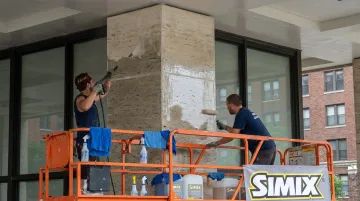
Ceramic coating systems address this gap directly. SIMIX's Cleaner and Ceramic Clearcoat system, for example, combines surface cleaning and a protective ceramic layer into one integrated process rather than treating them as separate steps.
- Removed embedded pollution and biological staining from a travertine marble façade at Milwaukee's MGIC Building, then formed a breathable protective barrier
- Delivers a 15+ year durability claim, well beyond the reapplication cycle of most paint-based products
- Requires reapplication every 3-7 years according to independent documentation for the exterior/concrete system, depending on substrate porosity and exposure severity
For facility managers and homeowners comparing long-term options, SIMIX's Ceramic Clearcoat is water-based and zero-VOC, while the companion peroxide cleaner is NSF-certified. Both align with the environmental priorities driving demand for low-toxicity exterior coatings.
Conclusion
There's no single "best" waterproofing paint for every wall. The right choice depends on matching the product to your substrate, your climate, and how much maintenance you're willing to take on over the years.
Once you've narrowed the field to a good fit, weigh three more things before buying: surface prep quality, the product's actual warranty terms, and true cost-per-year rather than sticker price. A cheap gallon that fails in three years isn't cheap at all.
If you're weighing longer-lasting, lower-maintenance protection beyond conventional paint, consider SIMIX's ceramic coating systems for exterior surfaces as part of your comparison.
Frequently Asked Questions
What is the best waterproof coating for walls?
It depends on your wall material and climate. DRYLOK works well for hydrostatic pressure on concrete, silicone-based creams suit brick and stone, and ceramic coatings suit longer-term, lower-maintenance needs.
What is the difference between waterproof paint and weatherproof paint?
Waterproof paint is specifically tested to block water penetration, often against hydrostatic pressure or wind-driven rain. Weatherproof paint offers broader protection against UV, temperature swings, and dust, but doesn't guarantee the same water-blocking performance.
How long does exterior waterproofing paint typically last?
It varies by formulation: acrylic paints often need recoating within a few years, elastomeric coatings can carry 20-year design lives, and penetrating sealers like SX5000 are rated for 7-10 years before recoating.
Can waterproofing paint be applied over damp or leaking walls?
Active leaks and structural dampness need to be repaired first. Most manufacturers, including DRYLOK and KILZ, specify dry or only slightly damp masonry, since paint applied over active leaks will fail prematurely.
Do I need a primer before applying waterproof masonry paint?
Not always. KILZ's masonry paint is self-priming, and Sherwin-Williams' Loxon XP doesn't require primer, but new or repaired masonry often benefits from a dedicated primer to improve adhesion.
Is a ceramic coating better than waterproof paint for long-term protection?
Ceramic coatings generally offer longer service intervals and less frequent maintenance than repainted waterproof coatings. Products like SIMIX's ceramic clearcoat, built for exterior surfaces and facades, are especially worth considering for commercial buildings or high-exposure walls where recoating labor adds up fast.