Introduction
Heat exchangers and HVAC coils never get a break. They cycle through heat and cold, sit in constant moisture, and collect airborne contaminants every single day. That kind of stress wears down bare metal fast.
The damage is often invisible until it's expensive. Corrosion and fouling strip away heat transfer efficiency, long before anyone notices a performance drop on the utility bill. By the time a facility manager spots the problem, thousands of dollars have already leaked out through inefficient equipment.
This guide breaks down why heat exchangers fail, the coating technologies built to stop it, and how to pick the right protection system for your equipment and environment.
Key Takeaways
- Corrosion and fouling cut thermal efficiency and shave years off equipment life
- Coating options include e-coating, epoxy, nano-coatings, and ceramic clearcoats, each suited to different substrates
- Advanced ceramic coatings can deliver 12-24% energy savings and cut maintenance costs by up to 40%
- The right coating maximizes ROI, safeguards indoor air quality, and extends long-term asset value
Why Heat Exchangers Fail: The Real Cost of Corrosion, Fouling & Scale
Bare metal surfaces exposed to humidity, condensation, and aggressive fluids don't stand a chance long-term. Tube surfaces, tube plates, and fins take the brunt of this exposure, and corrosion sets in steadily over months and years of operation. Industry research consistently identifies corrosion as one of the primary drivers of industrial heat exchanger failure, particularly in petrochemical and processing environments.
Fouling compounds the problem. Sediment, mineral scale, and biofilm build up on uncoated metal surfaces and act like an insulating blanket, blocking the heat transfer these systems depend on.
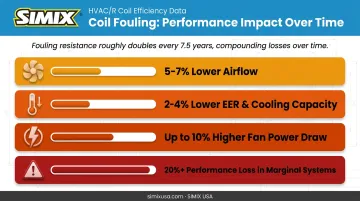
Lawrence Berkeley National Laboratory modeling backs this up: typical coil fouling can double pressure drop in roughly 7.5 years, which translates into:
- 5-7% lower airflow
- 2-4% lower EER and cooling capacity
- Up to 10% higher fan power draw
- Performance losses exceeding 20% in marginal systems
Reduced efficiency is only part of the story. Left unchecked, that same corrosion and fouling create a far more urgent failure mode: the pinhole leak.
The Pinhole Problem
A single pinhole leak can shut an entire system down. Refrigerant loss in a condenser or a breach in a turbine condenser tube doesn't just cause a minor repair. It can force a full stoppage while technicians locate and isolate the failure point. The same corrosion that thins tube walls also creates the pitted, damp surfaces where bacteria and biofilm take hold.
Corrosion, Fouling, and Indoor Air Quality
Damp coils and drain pans are exactly the kind of environment bacteria and mold-containing biofilms thrive in, according to ASHRAE research. That translates into real health risk for anyone breathing the air downstream of that coil.
A double-blind trial of 771 office workers found that UVGI treatment of coils and drain pans reduced surface microbial and endotoxin concentrations by 99%. Researchers linked this reduction to measurably fewer work-related respiratory and mucosal symptoms among workers. Keeping coil surfaces clean and free of biofilm buildup matters for more than efficiency. It protects the people breathing that air every day.
Weigh that against the cost of a preventive coating. It's a fraction of what a full coil or unit replacement runs, and it stops the problem before it starts.
Types of Heat Exchanger Protection Coatings Compared
There's no single "best" coating. The right choice depends on the substrate, the environment the equipment operates in, and whether the goal is corrosion resistance alone or corrosion resistance combined with improved heat transfer.
Electrophoretic Coating (E-Coating)
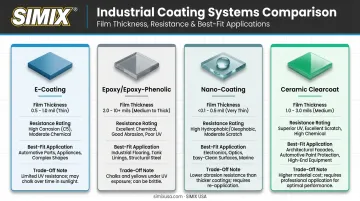
E-coating uses an electrical deposition process to lay down a uniform film, even across complex fin-tube geometries that are nearly impossible to coat evenly by hand. Documented product benchmarks show films as thin as 12.7-30.5 microns, with salt spray resistance exceeding 6,000 hours under ASTM B117 testing.
Best fit: HVAC coils, condensers, and evaporators manufactured with e-coating built into the factory process.
The catch: thickness has to stay razor-thin. Add too much film and you start impeding the very heat transfer you're trying to protect.
Epoxy & Epoxy-Phenolic Coatings
These coatings show up most often in shell-and-tube exchangers running seawater or aggressive industrial fluids, applied to tube interiors, tube plates, and water boxes. Dated technical data sheets report baked phenolic-epoxy films around 25 microns thick, withstanding temperatures up to roughly 180°C. Some formulations hold up through 30,000+ hours of accelerated salt spray testing.
The trade-off: application via spray or immersion is labor-intensive, and depending on service conditions, these coatings may need periodic reapplication to maintain their barrier.
Nano-Coatings
Nano-coatings create an ultra-thin, hydrophobic barrier, sometimes reaching water contact angles above 120 degrees, that promotes self-cleaning, anti-fouling performance. Research on plate heat exchangers found some nano-composite surfaces cut clean-in-place time by up to 70%.
One caveat: not every hydrophobic chemistry performs equally. In that same body of research, PTFE surfaces actually fouled worse than uncoated stainless steel in certain conditions. Hydrophobicity alone doesn't guarantee anti-fouling performance. Fluid-specific validation matters.
Ceramic Clearcoat Technology
Ceramic clearcoat systems offer a newer approach for HVAC coil environments. SIMIX's Multi-Surface Ceramic Clearcoat is engineered specifically to address what traditional e-coat or epoxy systems don't: corrosion resistance combined with heat transfer optimization at the air-metal interface, plus photocatalytic air-purifying properties on the treated surface.
The system works in two steps rather than one:
- Deep clean — The SIMIX Peroxide Cleaner & Degreaser strips existing fouling, oils, and corrosion byproducts from the coil surface first
- Ceramic layer — The clearcoat is then applied to the properly prepped substrate, locking in long-term protection
This sequencing matters. Coating over a dirty, contaminated surface compromises adhesion no matter how good the coating chemistry is. Traditional single-step coatings skip that preparation step entirely, which is one reason ceramic systems built around a cleaning phase tend to outperform them over time.
Proven Benefits & Real-World Results of Coating Protection
Numbers tell the story better than adjectives. Here's what documented coating protection delivers:
| Benefit | Result |
|---|---|
| Energy savings | 12-24% reduction in HVAC energy use |
| Maintenance cost reduction | Up to 40% fewer fouling/corrosion repairs |
| Coating longevity | Up to 20 years with proper maintenance |
| Germ/microbial reduction | 99.9% effectiveness against coronaviruses and other germs on treated surfaces |
The 20-year longevity figure isn't just a marketing number. It defers one of the largest capital expenses a facility faces: full HVAC equipment replacement.
Stretching the useful life of existing coils and condensers by years, rather than replacing them, changes the entire capital planning conversation for a facility manager.
Case Study: American Leadership Academy, Gilbert, Arizona
This is where the numbers get concrete. American Leadership Academy applied the SIMIX 2-Step System across 44 Trane rooftop units, totaling 215.5 tons of cooling capacity, spread over a 59,300-square-foot building. The project treated condenser coils, evaporator coils, and condenser fan blades.
Results, documented year-over-year:
- 21.52% reduction in HVAC energy (kWh) usage
- $17,005 in avoided energy costs
- Zero equipment replaced — the entire gain came from cleaning and coating existing infrastructure
No new units. No capital expenditure on hardware. Just a cleaner, protected coil surface doing what it was designed to do.
Cross-Industry Validation
This isn't a phenomenon limited to HVAC coils. The 2011 EPRI Condenser Symposium documented nearly 40 years of French nuclear steam-condenser materials experience, including epoxy-protected tube-plate and water box surfaces that held up across decades of service.
A coating system that performs across HVAC coils, food service kitchens, and power generation condensers alike proves the underlying protection mechanism works broadly across industries.
Application Process & Choosing the Right Coating Solution
Getting a coating to perform starts long before the coating itself goes on. The general workflow looks like this:
- Clean and degrease the surface: Remove oil, salts, corrosion byproducts, and existing scale before anything else
- Apply the coating: Spray, immersion, or electrocoat bath, depending on the system and whether it's factory or field-applied
- Cure or dry: Baked systems require controlled heat cycles; ambient-cure systems need specific time and humidity windows
Once the cleaning and coating steps are locked in, the next decision is matching the system to your facility's specific conditions.
Selection Criteria for Facility Managers
Before choosing a system, weigh these factors:
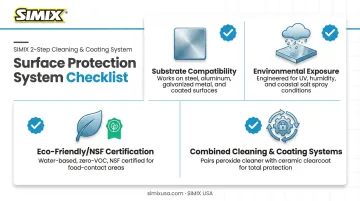
- Substrate compatibility: aluminum fins, copper tubes, and steel components each respond differently to coating chemistries
- Environmental exposure: coastal salt air, industrial pollutants, and high humidity all demand different protection levels
- Eco-friendly or NSF certification needs: critical for food service and healthcare facilities
- Combined cleaning and coating systems: a single integrated process (like SIMIX's 2-Step System) simplifies procurement and scheduling versus managing separate cleaning and coating vendors
Ceramic-coated surfaces need less frequent recoating and cleaning than traditional epoxy or e-coat systems. That said, no coating is truly maintenance-free. Build a periodic inspection schedule into your facility calendar, and you'll catch early wear before it becomes a repeat corrosion problem.
Frequently Asked Questions
What is the best coating for heat exchanger protection?
It depends on the operating environment and substrate. That said, ceramic coatings like SIMIX's Multi-Surface Ceramic Clearcoat are becoming the go-to choice for HVAC coil applications since they combine energy efficiency gains with strong corrosion resistance in one system.
How long does a heat exchanger protective coating last?
Basic epoxy coatings typically last a few years before needing reapplication. Advanced ceramic systems, with proper maintenance, can hold up for as long as 20 years.
Can coatings be applied to existing heat exchangers, or only new units?
Contractors commonly apply retrofit, field-applied coatings to existing equipment. Manufacturers, by contrast, typically apply e-coating during original production since it requires an immersion and oven-cure process.
Does coating a heat exchanger reduce its heat transfer efficiency?
Properly engineered coatings measure just microns thick and don't impede thermal conductivity. In many cases, they actually improve efficiency by keeping surfaces free of fouling that would otherwise insulate the coil.
How much does heat exchanger coating cost compared to full replacement?
Facilities typically treat coating as an operational expense rather than a capital expenditure, and it costs a fraction of what full equipment replacement runs.
How often should HVAC coils be recoated or maintained after treatment?
Intervals vary by coating type and environment. Advanced ceramic systems generally offer longer intervals between treatments than traditional epoxy or e-coat systems, though facilities should still schedule periodic inspections.