Many homeowners and facility managers don't realize how much a coating choice affects their cooling bills until after a monsoon season leak or a summer of skyrocketing HVAC costs. Elastomeric roof coatings offer one of the most cost-effective ways to fight back, extending roof life, reflecting heat, and sealing out monsoon rain in a single application.
This guide breaks down the top elastomeric coating options for Arizona properties, what separates a good product from a mediocre one, and how to match the right chemistry to your specific roof.
Key Takeaways
- Silicone, acrylic, polyurethane, and ceramic coatings differ in cost, ponding resistance, and lifespan.
- Substrate and drainage conditions should drive your coating choice, not price.
- Third-party certifications and Arizona case studies separate proven products from marketing claims.
- Surface prep and application timing matter as much as coating chemistry.
- Recoat intervals and cost-per-year tell you more than upfront price.
Elastomeric Roof Coatings in Arizona's Climate
Elastomeric coatings are flexible, liquid-applied membranes that stretch and recover as temperatures swing. That elasticity matters in Arizona, where a roof surface can swing more than 80 degrees between a summer night and midday sun. Rigid coatings crack under that stress. Elastomeric ones flex with it.
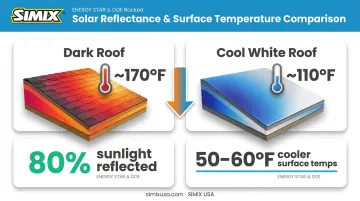
Reflectivity is the other half of the equation. A white, reflective surface bounces solar energy back before it converts to heat, while a dark surface absorbs it.
The temperature gap is significant:
- ENERGY STAR reports a clean white roof reflecting 80% of sunlight runs about 50°F cooler than a gray roof reflecting only 20% — see ENERGY STAR's cool roof guidance
- The Department of Energy has documented cool-roof surfaces staying up to 60°F cooler than traditional dark roofing during peak summer conditions
- In Arizona, that reflectivity gap translates directly into lower attic and interior temperatures throughout the summer months
Arizona cities have taken notice. According to a 2021 Phoenix municipal memorandum, the City of Phoenix reported a 17% energy-consumption reduction across city buildings after switching to cool-roof coatings. This figure comes from an independent city audit, adding real-world credibility to reflective-coating claims.
Not every elastomeric coating performs the same way under Arizona conditions, though. Chemistry, film thickness, and formulation all change how a product handles ponding water, dust pickup, and long-term UV degradation. That's where the comparison below comes in.
Top Elastomeric Roof Coatings for Arizona Homes & Businesses
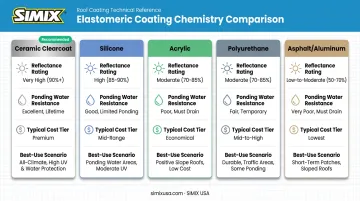
Five coating categories dominate the Arizona market. We evaluated each against five criteria: solar reflectance, resistance to UV and thermal cycling, ponding water performance, cost relative to service life, and independent certification or testing support.
SIMIX Ceramic Clearcoat System
SIMIX's Multi-Surface Ceramic Clearcoat is a different animal than a traditional thick, rubber-like elastomeric membrane. It's an ultra-thin, water-based ceramic film, applied as the second step in SIMIX's 2-Step Cleaner & Ceramic Clearcoat system, following a peroxide-based degreasing pass.
Rather than acting as an insulating barrier, the ceramic layer is engineered to shed condensate and resist dirt buildup while staying thin enough to avoid the thermal drag that thicker coatings can create.
On a documented white membrane roof application, surface temperature dropped from 154.6°F to 80.3°F after four coats, a swing of more than 74 degrees. That reduction held steady when re-measured nine months later, suggesting the effect isn't just a fresh-coat spike.
SIMIX's Arizona track record runs deeper on the HVAC side. At American Leadership Academy in Gilbert, Arizona, technicians treated 44 Trane rooftop units (215.5 tons of cooling capacity) across a 59,300-square-foot building using the same cleaner-plus-ceramic-clearcoat process.
The result: a 21.52% reduction in kWh usage and $17,005 in avoided energy costs, with zero equipment replacement. A similar deployment ran at a Waffle House location in Phoenix.
| Best For | Facilities and homeowners wanting a non-toxic, NSF-certified prep step and documented energy savings without a full membrane tear-off |
| Performance Profile | Rooftop temperature drops exceeding 74°F documented on white membrane roofs; sustained results at 9-month follow-up; zero-VOC, water-based |
| Cost Model | Retail gallon jugs ($349–$897) or combo kit ($399); quote-based pricing available for larger commercial roofs, often treated as an operating expense rather than a capital project |
Silicone Elastomeric Roof Coatings
Silicone systems are solvent-based, high-solids formulations built for one thing above all else: standing water. Manufacturers like Gaco explicitly state their silicone coatings withstand permanent ponding water without softening, which matters on Arizona's countless flat commercial roofs with imperfect slope.
One widely specified white silicone product, GacoFlex S42, carries a published 0.87 initial solar reflectance that settles to 0.69 after three years of weathering, with an SRI around 110 fresh and 84 aged, per its manufacturer product data sheet. That aged number matters more than the initial one: it's what you'll actually see after a few Arizona summers.
The tradeoff: silicone attracts dust more readily than other chemistries, and it gets slippery when wet, sometimes requiring granulated additives for foot traffic safety.
| Best For | Flat roofs with poor drainage or persistent ponding water |
| Performance Profile | Strong aged reflectance retention; excellent resistance to standing water and UV breakdown |
| Cost Model | Premium pricing relative to acrylic, reflecting solvent-based, high-solids formulation; Gaco backs some silicone systems with a 20-year no-dollar-limit warranty |
Acrylic Elastomeric Roof Coatings
Acrylic is the workhorse of the industry, widely used, easy to apply, and the most budget-friendly elastomeric option on the market. Henry's 587 Dura-Brite product lists an initial reflectance of 0.84, dropping to 0.73 after three years, with an SRI around 106 fresh and 90 aged.
The catch is water tolerance. That same product is only rated ponding-resistant for up to 48 hours, and application windows are tighter: manufacturer guidance calls for 50°F and rising ambient temperature, roof surface no hotter than 140°F, and no rain or cold snap forecast within 12 hours.
Key limitations to know:
- Reduced performance on roofs that hold water longer than a day or two
- Narrower application window during Arizona's cold mornings or monsoon humidity
- Typically backed by shorter warranty terms (Henry offers a 10-year limited warranty on its 587 line)
| Best For | Budget-conscious residential and commercial roofs with good, consistent drainage |
| Performance Profile | Strong initial and aged reflectance on well-drained surfaces; not built for standing water |
| Cost Model | The most economical elastomeric option per gallon; lower material cost offset by shorter warranty coverage |
Polyurethane (Urethane) Elastomeric Roof Coatings
Urethane coatings win on toughness. GacoFlex U91, an aromatic single-component urethane, tests at 2,600 psi tensile strength with 350% elongation per ASTM D412, figures that explain why urethane is the go-to choice for roofs with regular foot traffic or mechanical equipment.
The downside is UV stability. Aromatic urethanes yellow and chalk under prolonged sun exposure, which is why manufacturers recommend an aliphatic urethane topcoat for better color retention and reflectance.
Application also comes with a stronger chemical odor than water-based systems, and VOC content varies significantly by formulation (some compliant versions run under 50 g/L, versus 150 g/L for standard versions).
| Best For | Roofs with regular pedestrian traffic, rooftop equipment access, or mechanical foot paths |
| Performance Profile | High tensile strength and elongation for impact and puncture resistance; needs a UV-stable topcoat for long-term color and reflectance |
| Cost Model | Typically the highest per-gallon cost among elastomeric chemistries, justified by superior mechanical durability |
Asphalt/Aluminum-Based Elastomeric Coatings
These are the rescue option, economical products designed to rejuvenate aging modified bitumen or built-up roofs rather than serve as a long-term standalone system. KARNAK's 97 Fibered Aluminum coating, a common example, lists a 0.63 initial reflectance dropping to 0.55 after three years, noticeably lower than white silicone or acrylic products.
Henry's Pro-Grade 197 asphalt emulsion system can qualify for up to a 12-year material, labor, and workmanship warranty when installed as part of a full restoration system, though that warranty reflects installation quality more than raw coating lifespan.
| Best For | Older modified bitumen or built-up roofs needing an interim, low-cost restoration |
| Performance Profile | Lower reflectance than white elastomeric alternatives; functional but not a premium cool-roof solution |
| Cost Model | The lowest upfront cost of any category, making it common for short-term budget fixes rather than 20-year plans |
How We Chose the Best Elastomeric Coatings for Arizona
We weighted Arizona-specific performance data over generic national averages wherever it was available — aged reflectance after real desert weathering (where rooftop surface temperatures can exceed 150°F) matters more than a lab number measured on day one.
A common mistake we see: choosing a coating based purely on the lowest price per gallon. That decision skips crucial checks, including substrate compatibility, drainage conditions, and documented case-study performance in a similarly harsh climate, and it often leads to premature recoating, which erases any upfront savings.
Certifications and warranty terms carried real weight in this comparison, since they connect directly to long-term return on investment:
- ENERGY STAR certification confirms a coating meets federal reflectance minimums, which can qualify Arizona facilities for utility rebate programs
- CRRC-rated products (tested under ANSI/CRRC S100 methodology) provide standardized, third-party-verified reflectance and emittance data rather than manufacturer self-reporting
- Manufacturer warranty length often signals confidence in aged, not just initial, performance
How to Choose the Right Elastomeric Coating for Your Arizona Roof
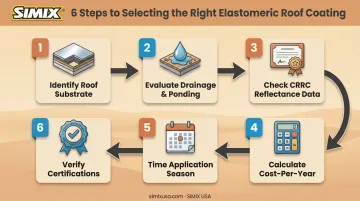
Picking a coating isn't a one-size-fits-all decision. Walk through these steps before committing:
Identify your roof substrate first. Flat single-ply membrane, metal, modified bitumen, and spray foam roofs each have different compatibility requirements, since a product built for TPO won't necessarily bond the same way to old built-up asphalt.
Evaluate drainage and ponding exposure. If water sits on your roof for more than a day after rain, silicone or a ceramic-hybrid system will outperform standard acrylic long-term.
Check CRRC-rated reflectance data, not just marketing numbers. Look for both initial and three-year aged solar reflectance and SRI values: the aged figures predict what you'll actually get after a few Arizona summers.
Calculate cost-per-year of service. A cheaper coating that needs recoating in five years can cost more over a decade than a pricier one rated for fifteen or twenty.
Time your application carefully. Avoid monsoon season and extreme heat days. Most water-based coatings need full evaporation before rain or dew arrives, and application windows typically require temperatures at 50°F and rising with the roof surface below 140°F.
Verify certifications and documented case studies. Ask for CRRC ratings, third-party test reports, and, ideally, real project data from a comparably hot, high-UV climate before signing a contract.
Conclusion
There's no single "best" elastomeric roof coating for every Arizona property. The right choice depends on matching your roof's substrate, drainage behavior, and maintenance budget to the right coating chemistry:
- Silicone excels on ponding-prone flat roofs
- Acrylic offers the best value for well-drained surfaces
- Urethane withstands foot traffic that would tear up softer coatings
Whatever you choose, prioritize documented Arizona performance data, real certifications, and honest maintenance expectations over glossy marketing claims. Facility managers seeking a ceramic-based alternative should look at SIMIX's roofs and exterior surfaces line. It delivers measurable, third-party-documented energy results from real Arizona sites, worth reviewing before you finalize your roofing budget.
Frequently Asked Questions
How long does roof coating last in Arizona?
Lifespan varies by chemistry and UV exposure. Manufacturer warranties range from 10 years on standard acrylic systems up to 20 years on premium silicone or ceramic-enhanced products, though real-world life depends heavily on maintenance and roof slope.
How much does it cost to coat a roof in Tucson, AZ?
Pricing varies by roof condition, size, and coating chemistry chosen, with asphalt-based systems generally the most affordable and urethane the most expensive per gallon. Get quotes from at least two contractors who can assess your specific substrate and drainage.
What is the best elastomeric roof coating for flat roofs in Arizona?
Silicone or ceramic-enhanced systems are typically preferred for flat roofs because of their superior resistance to ponding water and long-term UV degradation compared to standard acrylic.
Can elastomeric roof coating reduce cooling costs in Arizona homes?
Yes. Reflective coatings can meaningfully lower roof surface temperatures and HVAC load. SIMIX documented a rooftop temperature drop from 154.6°F to 80.3°F on a white membrane roof, sustained nine months after application.
Is elastomeric roof coating suitable for metal roofs in Arizona?
Most elastomeric chemistries, particularly acrylic and ceramic-enhanced systems, work well on metal roofing for rust prevention and UV protection. Confirm substrate-specific compatibility with the manufacturer before installation.
How often should Arizona roofs be recoated?
Recoat intervals depend on coating type, roof slope, and sun exposure, with premium systems generally lasting longer between applications. An annual inspection is the best way to catch reflectance loss or wear before it becomes a leak.