The problem? Every DIY recipe, pet spray, and commercial cleaner on the market claims to use hydrogen peroxide, but they're not interchangeable. A formula built for artificial turf won't touch commercial kitchen grease, and a drugstore bottle won't handle a musty basement.
This guide breaks down how hydrogen peroxide actually works on odors, ranks the top 5 hydrogen peroxide-based odor eliminators for different situations, and shows you how to match the right product to your specific problem.
Key Takeaways
- Hydrogen peroxide oxidizes organic odor compounds instead of masking them with fragrance
- Fresh odors from food, mildew, and light urine break down quickly with peroxide treatment
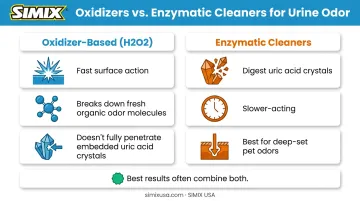
- Deep-set uric acid crystals resist peroxide alone and need enzymatic pre-treatment
- The right product depends on your odor source: surfaces, pet turf, room air, or commercial grease
- Five distinct hydrogen peroxide solutions are ranked below, each suited to a different use case
Overview of Hydrogen Peroxide as an Odor Eliminator
Hydrogen peroxide (H2O2) is a simple molecule: two hydrogen atoms, two oxygen atoms, nothing more. It decomposes into water and oxygen as it breaks down the organic material it touches. That decomposition process is exactly why it's prized as a "green" alternative to fragrance-based deodorizers: no harsh chemical residue, no synthetic perfume covering up the actual problem.
The CDC recognizes 3% hydrogen peroxide as a stable, effective disinfectant for inanimate surfaces. It produces destructive hydroxyl free radicals that attack cell membranes and organic matter.
OSHA has also documented hydrogen peroxide's established role in deodorizing textiles, wood pulp, and other organic materials. That's why it shows up in laundry boosters and industrial cleaners alike.
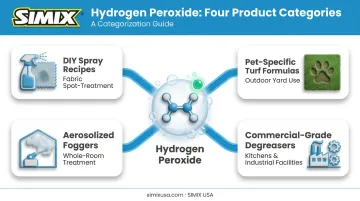
That growing recognition has fueled an entire market of hydrogen peroxide products:
- DIY spray recipes for spot-treating fabric
- Pet-specific formulas for turf and yards
- Aerosolized foggers for whole-room treatment
- Commercial-grade degreasers for kitchens and industrial facilities
Each one targets a different odor source, which is exactly why the rankings below split by use case rather than crowning one universal winner.
Top 5 Hydrogen Peroxide Odor Eliminators
These five products were selected based on proven oxidative effectiveness, surface safety, ease of use, and how well each one matches a specific odor source. None of them work identically, and that's the point.
SIMIX Multi-Surface Peroxide Cleaner & Degreaser
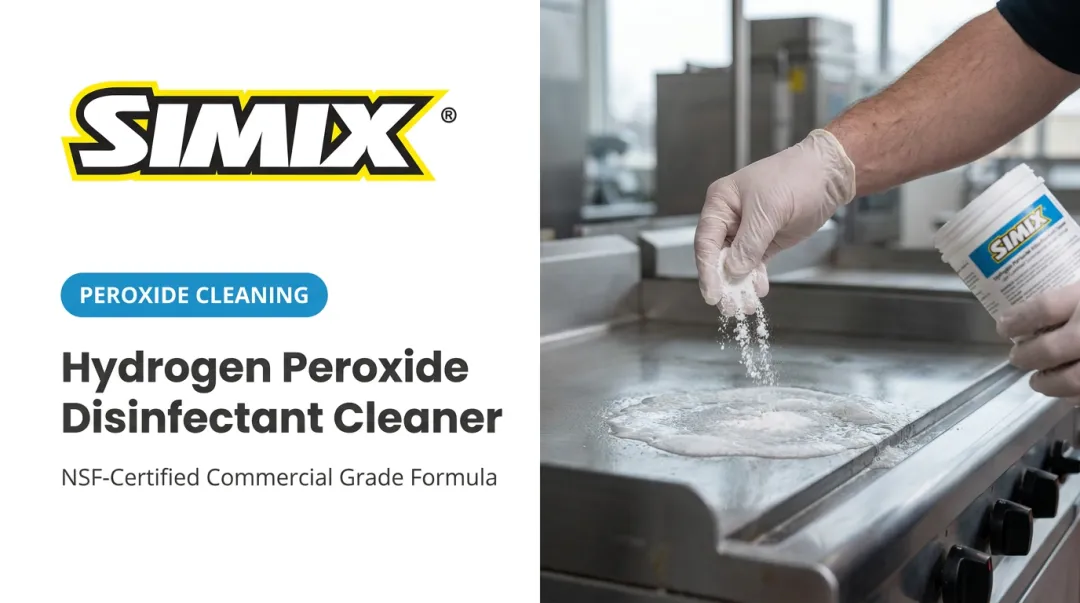
SIMIX makes an NSF-certified, water-based, zero-VOC peroxide cleaner and degreaser built for commercial kitchens, HVAC surfaces, floors, and industrial facilities where grease and organic buildup create persistent odor problems. It's sold as an ultra-concentrated 5 lb formula, priced between $75 and $225 depending on volume.
What sets it apart is the combination of oxidative chemistry with engineered surfactants that target grease and biofilm at the source, rather than just knocking down the smell temporarily.
Facility teams have deployed it in real kitchen environments, including a degreasing application at The Original Pancake House in Illinois. The goal there was cutting through baked-on grease without leaving harsh solvent residue behind.
| Category | Details |
|---|---|
| Best For | Commercial kitchens, HVAC coils, floors, and industrial surfaces with grease- or biofilm-driven odors |
| Key Technology | NSF-certified peroxide-based oxidative cleaner, paired with the SIMIX Ceramic Coating system for lasting protection |
| Notable Advantage | Non-toxic, zero-VOC formulation safe for food-service environments; often budgeted as an operating expense rather than a capital purchase |
This is the only option on this list designed as part of a two-step system. Clean first with the peroxide degreaser, then seal with a ceramic clearcoat that resists future grease and grime buildup, which means fewer repeat odor problems down the line.
Turf Mist Pet Odor Eliminator (H2O2 Formula)
Turf Mist is a hydrogen peroxide spray built specifically for pet urine odors on artificial turf and outdoor surfaces. It targets the bacteria responsible for that sharp ammonia smell, since urease-producing bacteria are what convert urea into ammonia in the first place.
The manufacturer states the formula is stabilized and pH-balanced specifically for synthetic turf fibers, infill, and backing, unlike raw 3% peroxide, which can be harsher on turf materials. Coverage runs roughly 500-1,000 square feet per gallon, and the product is marketed as heat-stable above 90°F.
| Category | Details |
|---|---|
| Best For | Pet urine odors on artificial turf and outdoor pet areas |
| Key Technology | Hydrogen peroxide oxidation combined with surfactants formulated for synthetic turf safety |
| Notable Advantage | Non-toxic and safe for pets and children; drying time is typically 10-15 minutes for surface contact |
One limitation worth knowing: oxidizers like this act fast on surface odor but don't always reach urine that's soaked into backing or subfloor. Cleaning industry guidance recommends pairing turf treatments with enzymatic products for deeply embedded uric acid crystals.
Breezy Blue Aerosolized Hydrogen Peroxide Fogger
Breezy Blue takes a different approach entirely: it aerosolizes hydrogen peroxide into a dry fog that fills an entire room, reaching carpets, drapes, and hard-to-clean corners that a spray bottle simply can't cover.
The manufacturer claims a single one-minute fogging cycle can treat up to 1,000 square feet, with a settling period of around 10 minutes before the space is ready for re-entry. That speed is the whole appeal for whole-room odors like musty basements, pet smells, or lingering tobacco smoke.
| Category | Details |
|---|---|
| Best For | Whole-room odor elimination in commercial or residential spaces (musty rooms, pet odors, tobacco smoke) |
| Key Technology | Aerosolized H2O2 that breaks down into oxygen and water vapor after neutralizing contaminants |
| Notable Advantage | One-minute fogging treats roughly 1,000 sq. ft.; no manual scrubbing required |
Keep in mind that aerosolized systems generally require good ventilation afterward. Independent reviews of similar aHP systems have noted full decontamination cycles, including dwell and aeration time, can run closer to an hour depending on room conditions.
DIY Hydrogen Peroxide Odor Eliminator Spray
For anyone spot-treating a fresh pet accident or a lingering food spill on a budget, the classic combination of 3% hydrogen peroxide, baking soda, and a few drops of dish soap does real work. The peroxide oxidizes organic material, the baking soda absorbs residual odor, and the dish soap helps break surface tension so the mixture penetrates fabric fibers.
This recipe costs a fraction of store-bought sprays, and most households already have the ingredients on hand.
The catch:
- It must be mixed fresh and used immediately (it can't be stored in a sealed container, since the reaction generates oxygen gas and pressure can build)
- Spot-testing is essential on colored fabric or carpet before full application
- It handles fresh organic odors well but won't dissolve deep-set uric acid crystals
| Category | Details |
|---|---|
| Best For | Spot-treating fabric, carpet, and upholstery odors on a budget |
| Key Technology | 3% hydrogen peroxide combined with baking soda's odor-absorbing action and dish soap's surfactant power |
| Notable Advantage | Costs a fraction of store-bought odor removers; ingredients found in most homes |
Standard 3% Drugstore Hydrogen Peroxide
Plain 3% hydrogen peroxide is the baseline option, cheap, everywhere, and genuinely useful for general household deodorizing. Refrigerators, cutting boards, laundry loads, and kitchen counters all benefit from a quick wipe-down or soak.
It's most effective on fresh organic smells. Research cited by Cleanfax on urine-contaminated surfaces found that soaking in 3% H2O2 for one to three hours reduced bacterial presence, though that measures disinfection rather than odor removal specifically.
| Category | Details |
|---|---|
| Best For | General household deodorizing (fridges, laundry, kitchen surfaces) |
| Key Technology | Standard 3% oxidative solution, most effective when paired with baking soda |
| Notable Advantage | Inexpensive, widely available, useful for far more than odor control |
One caution: hydrogen peroxide is a bleaching agent, so it can discolor dyed fabrics and natural fibers like wool if left on too long. Always test an inconspicuous spot first.
How We Chose the Best Hydrogen Peroxide Odor Eliminators
The biggest mistake people make is assuming every hydrogen peroxide product performs identically, regardless of the surface or the odor source. A turf spray and a commercial degreaser share a chemical backbone, but they're built for completely different jobs.
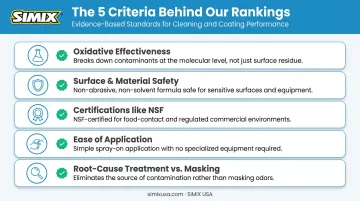
We evaluated each product against:
- Oxidative effectiveness on the specific odor-causing compound (grease, urine, mildew, VOCs)
- Surface and material safety, including risk of discoloration or fiber damage
- Certifications, including NSF, for food-service environments
- Ease of application, from spray-and-wipe to fogging systems
- Root-cause treatment versus temporary masking, since masking agents often fade within hours and let odors return
Only products that met most or all of these criteria earned a spot on our list below.
Conclusion
There's no single "best" hydrogen peroxide odor eliminator. The right pick depends on matching the product to your actual odor source, not just grabbing whichever bottle makes the boldest claim on the label.
Before you buy, think through surface compatibility, how often you'll need to reapply, and whether commercial-grade certification actually matters for your setting. A homeowner spot-treating carpet has very different needs than a facility manager running a commercial kitchen.
Commercial kitchens, HVAC systems, and industrial facilities often deal with persistent grease- or biofilm-driven odors that resist surface-level fixes. SIMIX's NSF-certified peroxide-based cleaner and degreaser targets that root cause instead of papering over it.
Frequently Asked Questions
Does hydrogen peroxide get rid of bad smells?
Yes, it oxidizes and breaks down many organic odor-causing compounds rather than masking them. However, it may not fully eliminate deep-set residues like uric acid crystals without an additional enzymatic treatment.
What is a natural odor eliminator for a house?
Hydrogen peroxide paired with baking soda, vinegar, and proper ventilation offers chemical-free alternatives to fragranced sprays. These options address the odor source rather than covering it with perfume.
What is the most powerful urine odor eliminator?
Enzymatic cleaners typically outperform hydrogen peroxide alone on urine because they digest uric acid crystals that oxidizers can't fully break down. Hybrid H2O2-enzyme formulas often deliver the strongest combined results.
Is hydrogen peroxide safe to use on all surfaces?
Not always. It can discolor natural fibers, colored fabrics, and certain finishes, so test an inconspicuous area before full application.
How long does a hydrogen peroxide odor eliminator take to work?
Surface sprays generally need a few minutes of contact time to oxidize odor compounds. Aerosolized fogging treatments typically require about 10 minutes of settling time for full effect.
Can hydrogen peroxide odor eliminators be used in commercial kitchens?
Yes, NSF-certified, peroxide-based degreasers like SIMIX are specifically formulated for food-service environments to safely break down grease and odor-causing compounds without leaving harsh chemical residue behind.