
Introduction
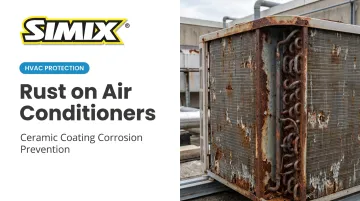
Step outside and look at your AC unit's cabinet. See any orange or brown flaking near the seams? That's not just an eyesore.
Rust on outdoor AC units is one of the most common (and most misunderstood) problems homeowners and facility managers face. Many people write it off as cosmetic, something to deal with eventually. But surface rust is often the first visible clue that corrosion is already attacking the metal underneath, reducing heat transfer and driving up energy bills.
Humid climates, coastal properties, and units that go years without a real inspection are especially at risk. This guide breaks down exactly why AC units rust, the warning signs to watch for, and the prevention strategies — including modern coil coating technology — that actually stop corrosion before it spreads.
TL;DR
- Rust forms from moisture, salt exposure, aging coatings, and skipped maintenance
- Corroded coils lose efficiency, forcing compressors to work harder and costs to climb
- Regular cleaning, drainage, and protective coatings stop most rust before it starts
- Ceramic coil coatings outlast standard rust-proof paint while preserving heat transfer
- Catching rust early saves thousands in avoided repairs and premature replacement
Common Causes of Rust on Air Conditioners
Outdoor AC components are built largely from copper, aluminum, and steel — metals that sit outside year-round, absorbing sun, rain, and airborne pollutants. Rust rarely comes from one single event. It's usually a slow buildup of environmental exposure layered on top of gaps in routine maintenance.
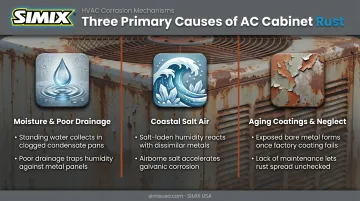
Moisture and Poor Drainage
Standing water is oxidation's best friend. If an outdoor unit isn't level, rainwater and sprinkler runoff can pool against the base of the cabinet instead of draining away, keeping metal surfaces wet for days at a time.
A typical scenario: a unit installed on uneven ground collects water at its base after every storm. That trapped moisture sits against the cabinet and coil fins, accelerating oxidation long after the rain has stopped.
This is especially common in clay-heavy soil, where even graded ground drains slowly. Adding a few inches of gravel beneath the pad often solves the problem for good.
Coastal Salt Air and Environmental Exposure
Salt particles carried on ocean wind settle directly onto coils and cabinets, acting as an electrolyte that speeds up corrosion far faster than inland exposure. Salt air can damage coils and shorten equipment life, according to trade research from ACHR News. The effect is worse where copper tubing meets aluminum fins, creating a dissimilar-metal reaction.
Homes and businesses within a few miles of the coast often see visible rust within just a couple of years. In some cases, this early corrosion has even complicated manufacturer warranty claims. Many manufacturers treat corrosion in high-salinity environments as an exclusion rather than a covered defect, leaving homeowners to cover replacement costs themselves.
Aging Coatings and Lack of Maintenance
Every outdoor unit ships with some level of factory-applied paint or coating. It holds up fine for a while, but no factory finish lasts forever: coatings gradually chip, fade, and thin out, especially at fasteners, seams, and edges where they were thinnest to begin with.
Once bare metal is exposed, rust doesn't wait around. It typically shows up first as small spots at screws and panel joints before spreading across larger sections of the cabinet.
Neglected debris speeds up the same process:
- Leaves and grass clippings trap moisture directly against coils and fins
- Pollen and dirt buildup blocks airflow and holds water after every storm
- Overgrown shrubs or nearby vegetation keep the unit shaded and constantly damp
A unit surrounded by yard debris is a textbook setup for accelerated rust, even in climates that aren't especially humid.
What Happens If Rust Is Ignored
Rust doesn't just sit there quietly. Corroded coils lose their ability to transfer heat efficiently, and the compressor compensates by running longer and harder to hit the same cooling target.
Fouled or corroded outdoor coils can measurably hurt performance. One peer-reviewed field study found that outdoor coil fouling reduced heat-transfer rates by more than 10% and cut overall cooling capacity by roughly 10-15%, with COP dropping by around 20%. That translates directly into higher energy bills for a system doing more work to deliver less cooling.
Left unaddressed, corrosion doesn't stay cosmetic. It can:
- Spread from the cabinet to structural fasteners and mounting brackets
- Perforate coil tubing, causing refrigerant leaks
- Void manufacturer warranties tied to corrosion damage
- Push a repairable unit past the point where replacement becomes the only option
Warning Signs of AC Rust
Catching these early can mean the difference between a $200 cleaning and a $5,000 replacement:
- Orange or brown flaking on the cabinet, coils, or fasteners — even small spots matter
- Rising energy bills or weaker cooling despite normal thermostat settings
- Water pooling near the unit's base or a musty smell coming from indoor vents
How to Prevent Rust on Air Conditioners
Preventing rust isn't complicated, but it does require consistency. It comes down to routine physical upkeep paired with a longer-term protective barrier applied at the right time.
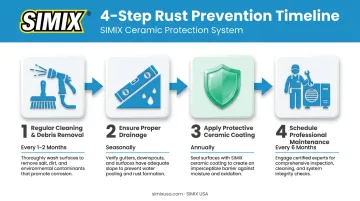
Prevention Measure 1: Regular Cleaning and Debris Removal
Gently brush or low-pressure rinse the coils and fins, and clear vegetation and debris from around the unit. This removes the trapped moisture and organic buildup that feeds oxidation.
When: Every 1-2 months during peak cooling season, and again after major storms.
Prevention Measure 2: Ensure Proper Drainage
Confirm the unit sits level, or tilted slightly to shed water rather than collect it. Standing water is the single most preventable driver of AC rust, so this step matters more than most homeowners realize.
When: At the start of every cooling season, and during any professional maintenance visit.
Prevention Measure 3: Apply a Protective Coating
Basic rust-proof spray paint offers limited protection and can actually insulate coils, reducing heat transfer. A purpose-built ceramic coating avoids that trade-off.
SIMIX's Multi-Surface Ceramic Clearcoat applies in two steps. First, SIMIX's peroxide-based degreaser deep-cleans the coil, stripping away existing corrosion byproducts, salt deposits, and grime. Next, an ultra-thin ceramic layer bonds to aluminum, copper, and steel, forming a barrier against moisture and salt that maintains — rather than blocks — thermal conductivity.
When: During new installation, or as a retrofit treatment on existing units before corrosion progresses to structural damage.
Prevention Measure 4: Schedule Professional Maintenance
A technician can spot early corrosion, check refrigerant levels, and clean coils more thoroughly than a garden hose ever will.
When: Once in spring before heavy cooling season, and once in fall.
Tips for Long-Term Prevention and Control
Rust prevention works best as an ongoing habit, not a one-time fix. A few practices make it easier to stay ahead of corrosion:
- Run seasonal self-inspections. A quick visual check every few months catches early rust spots before they spread.
- Keep a maintenance log. Note cleaning dates, coating applications, and any changes on the coils to see whether your routine is actually working.
- Think in systems, not spot treatments. Facility managers overseeing multiple units benefit from an integrated cleaner-and-coating program instead of chasing individual rust spots as they appear.
This systems-level approach has produced measurable results. At American Leadership Academy in Gilbert, Arizona, applying SIMIX's cleaner-and-ceramic-coating system to rooftop HVAC units (without replacing any equipment) cut annual energy costs by 21.52%, saving the school over $17,000 in a single year.
A separate SIMIX residential case study in Wisconsin documented a 34.74% drop in annual kWh consumption after coating both evaporator and condenser coils.
Conclusion
AC rust has clear, identifiable causes: moisture, salt exposure, aging coatings, and maintenance gaps. None of these causes are mysterious or unavoidable.
Consistent cleaning, proper drainage checks, and a ceramic protective coating like SIMIX's Multi-Surface Ceramic Clearcoat can prevent most rust problems long before they threaten your system's lifespan. That's a far cheaper path than waiting for a full compressor replacement.
Frequently Asked Questions
Is it safe to use a rusted air conditioner?
Light surface rust on the cabinet is generally safe short-term. Rust near electrical components, the compressor, or refrigerant lines is a different story and should be inspected by a professional promptly.
What is the $5,000 rule for air conditioners?
It's a contractor rule of thumb: multiply the repair cost by the unit's age. If that number tops $5,000, replacement usually makes more financial sense than repair.
What is the 3-minute rule for air conditioners?
Many technicians recommend waiting at least three to five minutes after powering off an AC before restarting it, letting internal pressure equalize. Exact timing varies by compressor model, so check your manufacturer's guidance.
What is the average lifespan of an air conditioner?
Most central AC units last 15 to 20 years with regular maintenance. Unaddressed rust and corrosion can cut that lifespan significantly shorter.
Can rust on an AC unit be repaired, or does it need full replacement?
Minor surface rust on non-critical parts can often be cleaned and treated. Heavy corrosion on the coil or compressor, especially with leaks or structural damage, usually calls for replacement.
Does a protective coating help prevent AC coil rust?
Yes. Ceramic and specialized anti-corrosion coatings create a long-lasting barrier against moisture and salt, offering more durable protection than standard paint while preserving coil efficiency. SIMIX's ceramic clearcoat, for example, is engineered specifically for HVAC coils to resist corrosion without sacrificing heat-transfer performance.