
Introduction
HVAC systems now account for 54% of total energy use in US commercial buildings when you combine space heating, cooling, and ventilation, according to EIA's Commercial Buildings Energy Consumption Survey. That's the single biggest line item on most facility energy bills.
Facility managers, HVAC engineers, and procurement teams are navigating overlapping cost and compliance pressures. New ASHRAE codes, carbon penalty laws like NYC's Local Law 97, and climbing electricity rates have pushed efficiency planning to the top of the budget agenda.
This article breaks down the five trends reshaping HVAC efficiency in 2026, what's fueling them, how they're changing daily operations, and what's likely coming next.
Key Takeaways
- Codes in the US, UK, and Australia are tightening at once, compressing upgrade timelines
- AI-driven fault detection is delivering measured energy savings in real commercial portfolios
- Heat pump adoption is accelerating through code mandates, not just market preference
- VFDs and ERVs remain the go-to retrofits for quick, measurable ROI
- Non-invasive coil treatments offer a low-capex path to cut HVAC energy waste
5 Key Trends Shaping HVAC Energy Efficiency in 2026
These five forces are defining where facility investment and compliance attention are headed this year.
Trend 1: Tightening Regulatory Standards Are Redefining the Efficiency Baseline
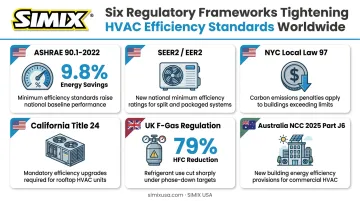
Six overlapping regulatory regimes are raising the efficiency floor at once:
- ASHRAE 90.1-2022 — DOE modeling shows it delivers 9.8% site-energy savings versus the 2019 edition
- SEER2/EER2 — Updated test procedures better reflect real installed performance for consumer air conditioning and heat pump systems
- NYC Local Law 97 — Most buildings over 25,000 square feet face steep financial exposure for excess emissions
- California Title 24 (2025) — Requires high-efficiency replacements for certain end-of-life rooftop units
- UK F-Gas rules — HFC quotas are dropping toward a 79% reduction by 2030
- Australia's NCC 2025 — New Part J6 controls efficiency standards for chillers, heat pumps, fans, and ducts
The financial stakes are real. Under Local Law 97, covered buildings pay $268 per excess metric ton of CO2e, according to NYC's official Local Law 97 guidance. For a mid-sized office tower exceeding its cap by even a few hundred tons, that adds up to a six-figure annual penalty.
Non-compliance now carries direct legal and financial risk. Efficiency has shifted from a maintenance nice-to-have to a board-level financial priority.
Trend 2: AI-Driven Analytics and Predictive Maintenance Are Going Mainstream
Building analytics platforms now catch problems that used to hide in plain sight: simultaneous heating and cooling, after-hours equipment running for no reason, setpoint drift, and economizer faults that waste energy for months without detection.
Lawrence Berkeley National Laboratory tracked fault detection and diagnostics tools across 550 buildings and 97 million square feet, finding median whole-building energy savings of 8%, according to LBNL's fault detection research. That's not a theoretical number. It's measured performance across real commercial portfolios.
These faults matter because they're invisible without data. A stuck damper or drifting setpoint doesn't set off an alarm. It just runs up the utility bill month after month until someone notices the pattern. That's exactly why more facility teams are adding analytics layers on top of existing BMS platforms.
Trend 3: Electrification and Heat Pump Adoption Are Accelerating
Regulatory pressure is pushing commercial buildings toward all-electric HVAC faster than market demand alone would drive it. California's 2025 Title 24 update requires certain end-of-life rooftop unit replacements in stores, offices, schools, and libraries to meet high-efficiency standards, which often means heat pumps.
The state projects the full code update will save $4.8 billion and avoid 4 million metric tons of greenhouse gas emissions over 30 years.
The UK's shrinking F-gas quotas and bans on high-GWP refrigerant equipment are pushing the same direction across the Atlantic. In Australia, NABERS reports that 74% of commercial offices, covering 21 million square meters, now receive annual energy ratings. Offices rated over multiple periods show average energy savings of 42%.
Heat pumps aren't the alternative anymore. For a growing share of new installs and major replacements, they're the default.
Trend 4: VFDs and Energy Recovery Ventilation Deliver the Fastest Retrofit ROI
Variable frequency drives match motor speed to actual demand instead of running fans and pumps at full tilt all day. The physics here are dramatic: because fan power scales with speed cubed, dropping speed just 20% cuts theoretical power draw by nearly 49%.
Real-world results back this up. JCPenney's VFD retrofit across 131 locations produced 47.8 million kWh in savings, a 22% reduction, with an estimated 1.7-year payback.
Energy recovery ventilators complement this by capturing energy that would otherwise be exhausted outside. ASHRAE data puts typical total effectiveness at 55-80%, meaning a well-designed ERV recovers most of the heating or cooling energy already spent on incoming air.
Why it matters: These upgrades don't require replacing core HVAC equipment. That makes them a common first move in any compliance or efficiency plan, especially when capital budgets are tight.
Trend 5: Non-Invasive Coil and Surface Treatments Are Emerging as a Low-Capex Efficiency Lever
Not every efficiency win requires new equipment. Ceramic coil coatings and cleaning systems restore heat transfer efficiency on units already installed, and because they're consumable treatment products rather than capital equipment, they're typically booked as an operational expense.
A documented example: American Leadership Academy in Gilbert, Arizona treated 44 Trane rooftop units (215.5 tons of combined capacity across a 59,300-square-foot building) with SIMIX's peroxide-based cleaner followed by its ceramic clearcoat. The result was a 21.52% reduction in HVAC energy use and $17,005 in documented savings, with zero equipment replaced.
That result sits within a broader pattern SIMIX has documented across commercial applications:
| Application | Result |
|---|---|
| Cleaning stage alone | 8-12% contribution to energy savings |
| Ceramic coating stage alone | Additional 8-12% contribution |
| Combined system (commercial) | 12-24% total HVAC energy reduction |
Why this matters: It gives facility managers a fast-to-approve, low-disruption lever to cut energy costs and stretch equipment life, without waiting for the next capital budget cycle.
What's Driving These HVAC Efficiency Trends
A mix of technology, cost pressure, and regulation is accelerating all five trends at once.
- Technology maturity: Cheap IoT sensors and AI fault detection, plus new ceramic coatings, deliver efficiency gains without touching equipment internals
- Market and tenant expectations: Green-rated buildings earn rent premiums of 7.1% in North America and 11.6% in London, per JLL research
- Rising energy costs: US commercial electricity hit 13.54 cents per kWh in May 2026, up 4.7% year over year, tightening project payback math
- Regulatory deadlines: The codes noted above carry compliance timelines running through 2026-2030, not optional guidelines
- Competitive certification pressure: Buildings increasingly compete for tenants using ENERGY STAR and LEED scores, rewarding those that act before mandates force the issue
How These Trends Are Impacting the HVAC and Facilities Industry
These shifts are changing how facilities operate, invest, and staff for HVAC management.
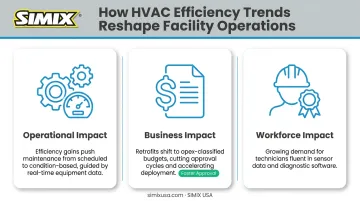
Operational Impact: Maintenance is moving from calendar-based schedules to condition-based, data-informed workflows. Instead of servicing equipment every quarter regardless of actual condition, teams are using analytics to flag problems as they emerge. Retrofit technologies like coatings, VFDs, and ERVs are getting folded directly into existing maintenance schedules, stretching service intervals rather than adding new line items.
Business Impact: Capital allocation is shifting toward opex-classified retrofits that defer expensive equipment replacement. Because treatments like coil coatings don't require capital authorization, procurement approval happens faster, often at the facility manager level rather than needing board sign-off. One Arizona school district documented a 21.52% HVAC energy reduction and $17,005 in savings after a coil-coating retrofit, with no equipment replaced.
Carbon reporting laws are also tying HVAC performance directly to balance-sheet risk. A poorly performing rooftop unit isn't just a comfort issue anymore; it's a potential penalty line item.
Workforce Impact: Demand is growing for HVAC technicians who can read BMS dashboards and interpret fault data, not just turn wrenches. Training needs are expanding into new retrofit application techniques too, from coating application procedures to control-loop tuning, as facilities lean more heavily on non-invasive treatments.
Future Signals for HVAC Energy Efficiency Beyond 2026
Facility teams should watch three things over the next 1-3 years:
- State-by-state code adoption: ASHRAE 90.1-2022 adoption timelines and expanding heat pump mandates will signal where the next wave of requirements lands
- Digital twins and expanded coatings: AI-driven whole-building energy modeling is maturing, and surface treatment technology is expanding beyond HVAC coils into full building envelopes
- A retrofit-first mindset: Expect facilities to layer VFDs, ERVs, analytics, and coil treatments together before considering full equipment replacement as a first resort
The likely scenario for 2027 and beyond favors combinations of low-capex measures stacked together rather than one dominant technology winning out. Full replacement stays reserved for equipment that's genuinely at end of life.
Conclusion
HVAC energy efficiency in 2026 is being shaped by tightening codes, smarter analytics, electrification momentum, and low-capex retrofit technologies working together. Facilities adapting early through data monitoring and non-invasive upgrades like coil treatments gain both a financial and compliance edge over those waiting for mandates to force their hand.
Strategic foresight, rather than reactive equipment swaps, separates efficient facilities from costly ones in the years ahead. Teams evaluating their next move can review SIMIX's HVAC treatment options, including the documented 21.52% HVAC energy reduction and $17,005 in savings achieved at American Leadership Academy in Gilbert, Arizona.
Frequently Asked Questions
Is there a tax credit for energy-efficient HVAC?
Federal incentives like the Section 179D commercial buildings deduction may apply to qualifying HVAC upgrades that meet minimum modeled energy-savings thresholds. Eligibility and amounts change year to year, so verify current terms with a tax professional or your local utility program.
What is the best way to save energy with my HVAC?
Combine the basics with targeted upgrades: regular maintenance, sealed ductwork, and smart thermostats, plus low-capex retrofits like coil treatments or variable frequency drives (VFDs). Together these typically deliver the most measurable savings for the least disruption.
What is the best energy-saving HVAC system?
High-SEER2/EER2-rated heat pump systems are currently top performers for most commercial applications. That said, the right system depends on building size, climate, and load requirements, not just the highest rating on paper.
What SEER2 rating should I look for in 2026?
Regional minimums currently sit around 14.3 SEER2 in southern states and 13.4 SEER2 in northern states for consumer split systems. Higher ratings mean better efficiency, but weigh the added cost against your building's actual usage profile.
How much energy can HVAC coil coatings actually save?
Documented case results, including a 21.52% HVAC energy reduction at American Leadership Academy, fall within the broader 12-24% savings range typically reported for SIMIX ceramic coil coatings on commercial HVAC equipment.
How often should commercial HVAC systems be serviced to maintain efficiency?
Plan on seasonal inspections at minimum, with filter changes every 1-3 months. High-use commercial systems, like those in hospitals or restaurants, need more frequent checks to prevent efficiency loss between service visits.